

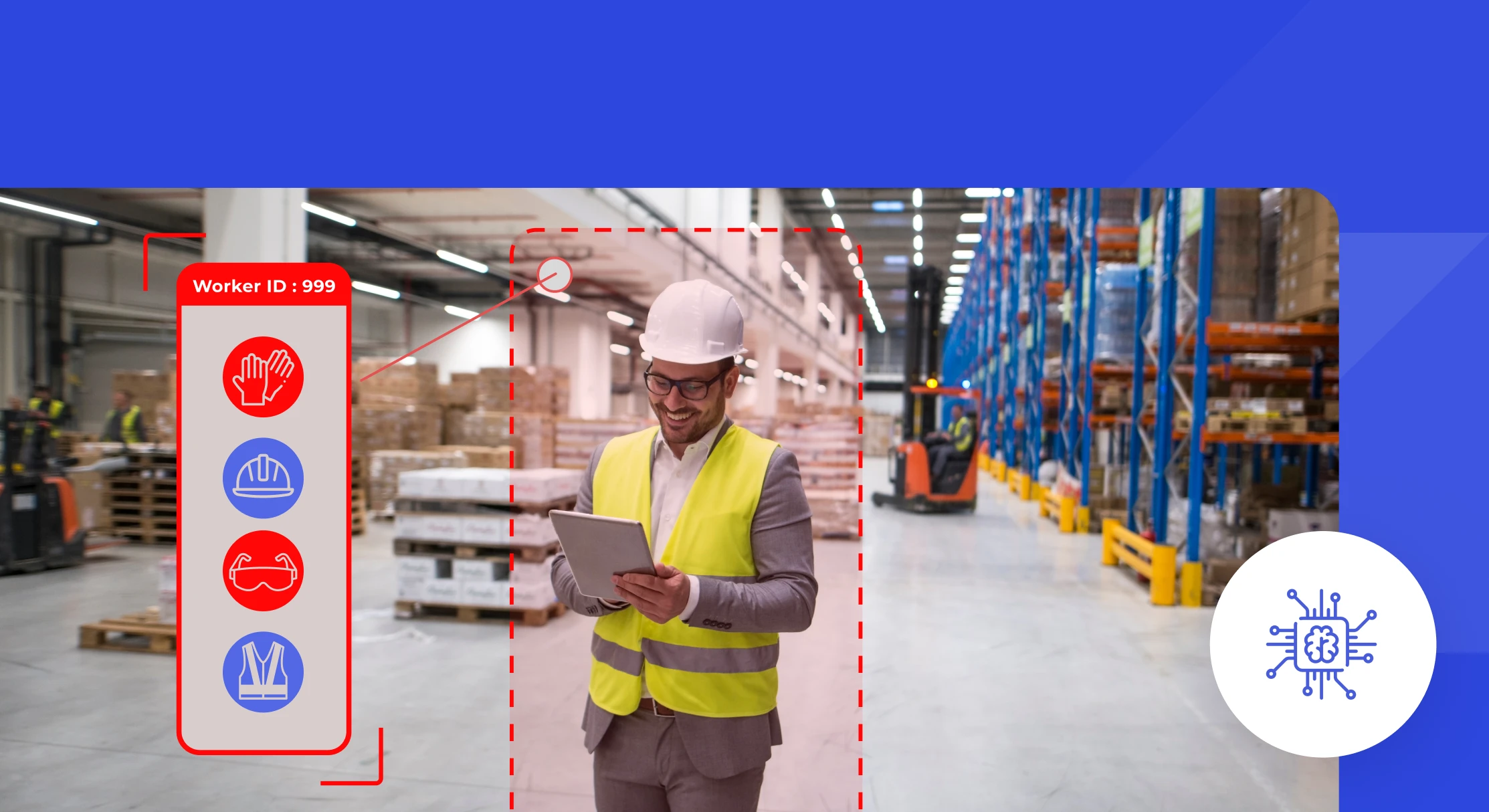
Detecting PPE compliance with AI transforms workplace safety by automatically analyzing video feeds from existing cameras to verify if workers are wearing required personal protective equipment—such as helmets, vests, gloves, goggles, and masks—in real time using computer vision and machine learning. AI-powered systems eliminate manual inspection gaps and ensure consistent PPE detection across all zones of a jobsite, providing continuous monitoring that catches violations the moment they happen.
PPE compliance refers to ensuring that employees consistently use the right personal protective equipment (PPE usage)—such as helmets, gloves, goggles, and masks—to reduce exposure to hazards that can cause workplace injuries or illnesses. Personal protective equipment is designed as a barrier to protect workers when engineering and administrative controls are insufficient to mitigate risks.
Achieving compliance isn’t just about following rules—it’s essential for workplace safety because proper PPE significantly lowers the likelihood of accidents, reduces long-term health risks, and fulfills legal safety obligations that help avoid fines or legal consequences.
AI-driven PPE detection systems use advanced computer vision and machine learning to automatically analyze live video feeds and verify whether workers are wearing required personal protective equipment (PPE) — such as helmets, vests, masks, gloves, and boots — enabling real-time PPE compliance detection without manual supervision. These AI-powered PPE monitoring tools integrate with existing CCTV or IP camera networks and continuously evaluate every frame to spot missing or improperly worn PPE, triggering immediate alerts to supervisors so corrective action can be taken within seconds
Computer vision PPE detection uses object detection and deep learning models to analyze video frames, identify workers, and recognize required safety gear such as helmets, vests, gloves, goggles, and masks with high accuracy. An AI-based PPE detection system is trained on labeled image datasets so it can distinguish between compliant and non-compliant behavior under different lighting, angles, and site conditions, enabling reliable PPE recognition in real time.
By learning visual patterns directly from images, deep learning models continuously improve detection performance, allowing organizations to automate safety checks, reduce human error, and maintain consistent PPE compliance monitoring across industrial environments—without relying on manual inspections.
Real-time PPE monitoring systems are AI-powered monitoring systems that continuously analyze live camera feeds to detect whether workers are wearing required personal protective equipment, enabling automatic PPE compliance monitoring without manual checks. These solutions automatically identify missing or improperly used protective gear and generate real-time alerts, allowing safety teams to take immediate corrective action and reduce workplace hazards.
By leveraging real-time detection systems based on video analytics and deep learning, companies can eliminate compliance blind spots, log timestamped events for audits, and maintain a consistent safety standard across all work zones, which also supports proactive safety improvements and regulatory adherence.
Continuous PPE monitoring refers to nonstop surveillance that uses AI-powered detection to track whether workers are wearing required personal protective equipment throughout their shifts, ensuring no lapse in oversight unlike periodic manual checks. This approach automatically logs compliance data and PPE compliance tracking events in real time, helping teams identify and correct unsafe behavior instantly before it leads to incidents.
By integrating workplace safety monitoring with continuous AI analysis, organizations gain a full audit trail of PPE usage—including violations with timestamps and alerts—so safety managers can improve protocols, reduce human error, and support regulatory compliance more effectively.
AI systems can automatically identify a wide range of personal protective equipment (PPE detection) items to ensure PPE usage monitoring and industrial PPE detection, improving safety and compliance across worksites. Common gear recognized includes hard hats (safety helmets) to protect against head injuries, protective gloves for hand safety, high-visibility vests that enhance worker visibility, and safety eyewear (goggles) to shield eyes from debris and chemicals.
Advanced monitoring also extends to face masks for respiratory protection, protective boots for foot safety, ear protection to reduce noise damage risks, and fall-protection harnesses in elevated work zones, all of which can be tracked through AI-driven compliance tracking. In more comprehensive setups, AI systems can detect aprons, reflective clothing, and respiratory protective equipment, offering a full spectrum of PPE recognition to enhance workplace safety monitoring and reduce injuries.
AI systems can accurately identify critical safety equipment using PPE object detection technology that analyzes surveillance video to confirm whether workers are wearing required gear like hard hats and safety vests in real time, improving both compliance and safety outcomes. For example, advanced vision models detect helmets and high-visibility vests and categorize workers based on compliance status (fully protected, missing helmet, missing vest, or unprotected) to provide clear safety insights.
This form of protective gear detection continuously scans camera footage and flags violations instantly, ensuring that supervisors can address missing PPE before incidents occur and maintain consistent workplace safety monitoring across all zones.
In video-based PPE detection, AI systems continuously process live footage from cameras to analyze each frame for people and required personal protective equipment, creating an end-to-end monitoring workflow that leads to a clear PPE compliance decision. First, the AI model detects workers and the presence or absence of helmets, vests, gloves, masks, and other gear; then it verifies if the detected equipment matches predefined compliance rules and flags any violations instantly.
Integrating AI into PPE compliance detection delivers major AI-powered workplace safety advantages by providing continuous monitoring that reduces human error and ensures consistent enforcement of safety protocols across every shift and zone, preventing unsafe behavior before it leads to incidents. AI systems automatically flag non-compliance, generate real-time alerts, and create data-driven insights that help safety teams address patterns of risk and improve training and procedures.
AI-driven systems for industrial PPE compliance are being widely deployed in factory floors and construction sites to continuously monitor whether workers wear required personal protective equipment, helping enforce safety standards and reduce risk in high-hazard settings. These solutions analyze live video feeds to detect missing helmets, vests, gloves, and other gear, automatically logging violations and providing real-time alerts to safety teams — eliminating gaps left by manual checks.
In factory safety monitoring, AI systems can be tailored to different areas and tasks (e.g., production lines, hazardous zones) with configurable rules that trigger alerts and generate compliance reports, ensuring consistent oversight across complex operations. Similarly, construction PPE detection leverages vision AI to enforce helmet and vest usage across active sites regardless of lighting or scale, helping organizations proactively prevent injuries before they occur.
The future of PPE detection lies in systems that go beyond simple rule enforcement to become AI compliance systems capable of predictive analytics and smart insights, allowing safety teams to anticipate hazards before they occur rather than just react to violations. Advanced AI models are increasingly integrating wearables and RFID data with video analytics, creating smart PPE monitoring ecosystems that not only detect missing equipment but also analyze patterns and risk zones for proactive intervention.
Emerging trends include predictive safety analytics that forecast high-risk conditions based on historical compliance data, personalized safety training driven by individual behavior trends, and digital twin simulations that help plan safer facility layouts—collectively shaping the future of AI-powered workplace safety by embedding intelligence into every layer of monitoring and response.
This website stores data such as cookies to enable site functionality including analytics and personalization. By using this website, you automatically accept that we use cookies.