

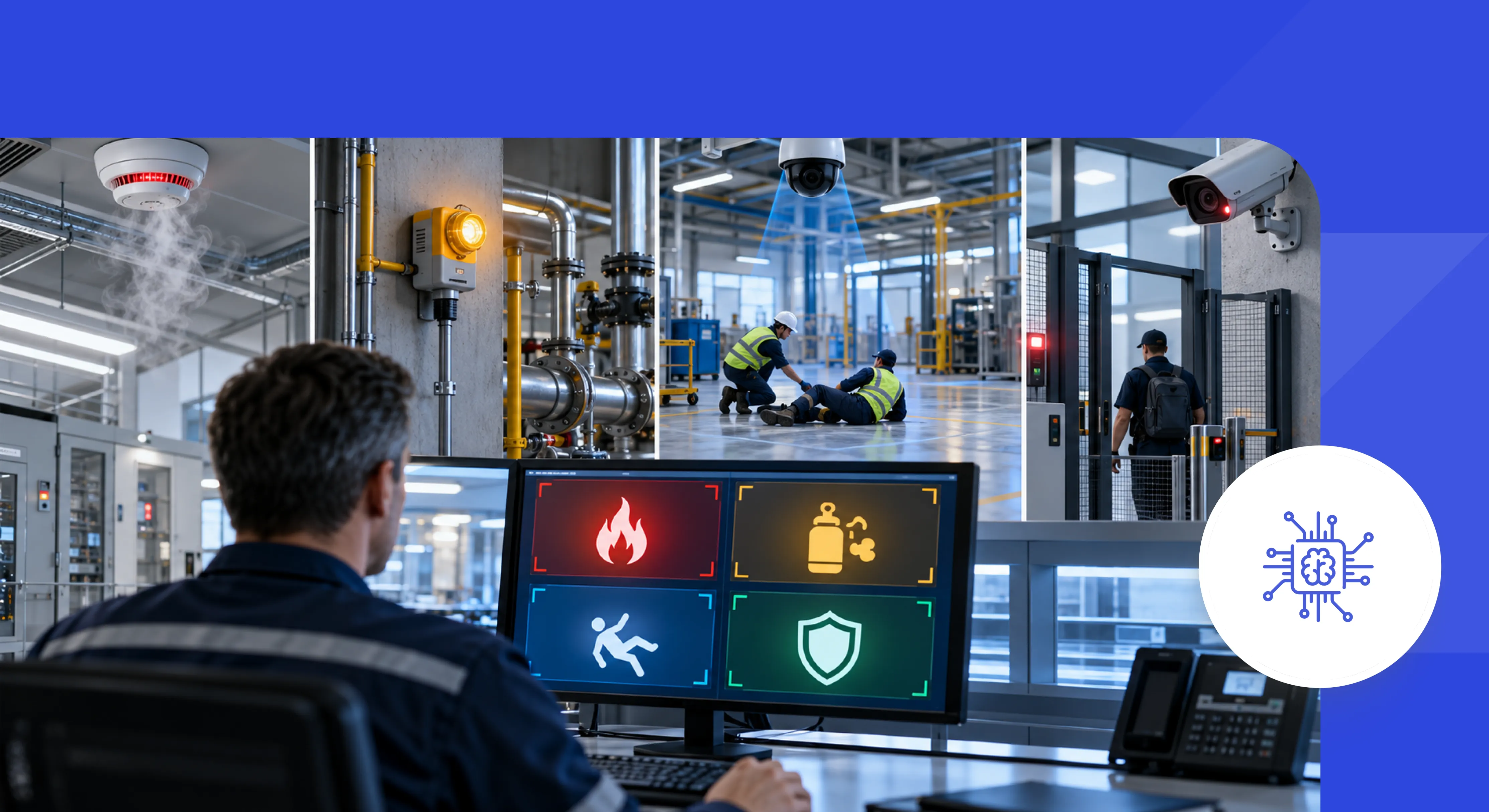
The main types of emergency detection systems are categorized by the hazard or event they are designed to identify. Common detection systems include fire and smoke detection, gas and chemical detection, intrusion and security detection, environmental monitoring, and AI-based emergency detection for events such as falls, accidents, and abnormal activity.
Fire detection and alarm systems continuously monitor an environment for signs of fire, typically using smoke detectors, heat detectors, or flame detectors. When a detector identifies a fire condition, it sends a signal to the alarm system’s control panel, which processes the signal and activates audible or visual alarms to warn occupants and support emergency response.
Real-world example: In a warehouse, a smoke detector can identify combustion particles and send an alert to the control panel. The panel can then activate sounders and visual alarms, helping employees begin evacuation before the fire spreads.
Medical emergency detection systems use wearable devices, mobile units, sensors, or monitoring technology to identify or report a medical emergency, such as a fall or a situation where a person cannot call for help. When an emergency detection event is triggered, the monitoring system can connect the person with a trained response specialist, caregiver, or emergency services, depending on the system’s configuration
Hazardous materials are detected using chemical sensors, gas detectors, portable analytical instruments, and spectroscopy-based technologies that can identify toxic, combustible, or otherwise dangerous substances. Depending on the material and environment, systems may detect chemical signatures, gas concentrations, vapors, radiation, or trace substances and then trigger an alert when predefined thresholds or hazardous conditions are identified.
Wireless emergency detection systems use connected sensors, monitoring devices, or communication networks to identify a hazardous event and transmit an alert without relying on physical wiring. When an emergency is detected, the system can send wireless emergency alerts to designated devices, monitoring centers, or response teams, while technologies such as cellular networks and wireless communication protocols help deliver notifications quickly across an affected area.
Emergency detection systems support emergency response systems by identifying hazards early and transmitting actionable alerts to the people responsible for responding. When an emergency situation occurs, detection technologies can provide information about the type and location of the incident, helping trigger alarms, evacuation procedures, notifications, or response protocols more quickly.
OSHA notes that automatic detection systems can provide early warning to occupants and emergency personnel, while effective alarm systems should support the actions defined in an emergency plan.
Detection identifies a potentially hazardous condition, while an alarm provides an immediate warning when that condition requires action. An alert communicates information about the detected event to a person or response system, whereas a notification delivers that information through a specific communication channel, such as SMS, email, an app, or a control panel. In practice, the sequence can be understood as detect → alarm → alert → notify, although systems may combine or perform these functions simultaneously.
|
Term |
Primary function |
Example |
|
Detection |
Identifies a hazard or event |
Smoke detector detects smoke |
|
Alarm |
Provides an immediate warning |
Siren or flashing light warns occupants |
|
Alert |
Communicates information about an event |
Security team receives a fire alert |
|
Notification |
Delivers information through a communication channel |
SMS notifies designated personnel |
Different emergency detection systems are selected according to the type of hazard, the environment, and the required response. Fire alarms typically rely on smoke, heat, or flame detection, while systems for a medical emergency may use wearable devices, sensors, or monitoring technologies; hazardous material incidents can require gas detection and specialized monitoring to identify dangerous substances and support emergency response.
Fire emergencies: Smoke, heat, and flame detection systems with fire alarms.
Medical emergencies: Wearable, fall-detection, or personal emergency response systems.
Hazardous material incidents: Gas, chemical, and hazardous-atmosphere detection systems.
Security emergencies: Intrusion, access-control, and video-based detection systems.
Environmental emergencies: Sensors for temperature, water leaks, air quality, and other hazardous conditions.
Workplace emergencies: Integrated emergency detection systems connected to an emergency alert system and employee alarm channels
You might be interested in:
How Emergency Detection Systems Work
This website stores data such as cookies to enable site functionality including analytics and personalization. By using this website, you automatically accept that we use cookies.